So as the time draws nearer for me to go home, I am caught between the fact that I'm going to miss so many things about Japan--the wonderful friends I've made, the foods and such that I can only get here, looking around me and seeing that everyone is Japanese, etc.--and the fact that I really miss my family and friends at home.
I think that this is the first time where I have had to leave a place where I have made so many dear friends and I don't know if I will even see them ever again. Then again, I have never lived in a place away from home for so long before. To leave the people here is like leaving behind a second family. They aren't as close as my true family of course, and I don't always feel that I can push myself upon them and open up as easily as I can to my true family, but that doesn't change the fact that I have come to love so many people here.
When I talk to other people about this, they often sympathize with me and think the same way, but today, one my friends said, "Yeah, I'm going to miss the fun times, because those were great. But the tough times were really tough." Yeah. That's true. Having to deal with sickness, sadness, loneliness, heartbreak, etc. all on my own has been truly hard on me. In general, I'm a 'sabishigariya', someone who doesn't handle loneliness very well, and I'm not very good at keeping my feelings to myself. I think I'm probably someone who needs someone else to spit my feelings and emotions out to, or else it builds up and up until finally it overflows one day in a flood of tears. And then to act normal in front of everyone right after that overflow and no one ever knows about those tears is painful, too. Perhaps I'm being selfish and childish to expect others to support me whenever I feel down.
Anyways, it's not over yet! Two more months to enjoy and suffer through the good times and the bad times and build up and enrich the being called Kenia.
Friday, June 8, 2012

Monday, May 28, 2012
Sometimes I have doubts about English...
When you're studying a foreign language, especially in that foreign language's country, you begin to doubt your native language.
For example, my grandpa Satou-san is really smart and knows a lot of English and just knows a lot of things, especially when it comes to words. I love word games and such, so I love to hear all his stories and about all the knowledge he has. The other day at my conversation club, Satou-san talked about the word groups high, tall, and takai and cold, samui, tsumetai.
In English, there is a difference between high and tall, while in Japanese there is one word to describe them both: takai. If a balloon is up in the air, it's high in English, takai in Japanese. If a person is tall, they are also takai. So, in English, there's a difference between elevation--an object's position in the air/atmosphere without necessarily a base--and height--an object with a base on the ground with a measurable distance from that ground base to its peak. Japanese doesn't have that difference. Everything is just takai. Not to mention, takai is used to mean expensive--as in a high price--but that's another story.
So, Satou-san asked everyone in the club, what do you call a person? Tall. What do you call a building? Tall. What do you call a mountain? High. But then, I was like, what? That's not right. A mountain is tall! It confused me that everyone was so unified on the fact that a mountain was high. Tall sounds more natural. But then again, it is true that I've heard a mountain be called so-and-so feet high before. So, I looked it up today, and apparently, a mountain is both! When you're talking about a tall mountain, you're referring to the distance from its ground base to its peak. When you're talking about a high mountain, you're referring to the distance from sea level to its peak. So, Mount Everest may be the highest mountain in the world, but Mauna Kea in Hawaii is the tallest mountain in the world. In my opinion, that difference is kind of strange and a pain to think about, but apparently, it exists. In Japanese, however, you don't have to worry about it. It's takai either way.
Now to give an opposite example, where Japanese has more words than English, there is cold, samui, and tsumetai. In this case, samui refers to coldness of atmosphere, temperature of a place, while tsumetai usually refers to coldness of the touch or taste. Sure, English has chilly/chilled, which is pretty close to tsumetai but it's not exactly the same. For example, a place can be chilly, but although the air may be called tsumetai, a place would be samui. A beer may be called chilled, but it can also be called cold. When you're drinking the beer, you wouldn't say 'this beer is chilled', but rather, more naturally, 'this beer is cold'. In Japanese, a beer is never samui. It is tsumetai. I found myself making the mistake today twice when I was holding a cold drink and eating a frozen yogurt, of saying 'samui!'--it's cold. Natural in English, but in Japanese, the correct thing to say is 'tsumetai!' because I'm directly touching/tasting something. In relation to heat, English has hot and warm and Japanese has atsui and atatakai, so it comes out naturally. When I want to say a drink is warm, I'll say atatakai. If something is hot, atsui. However, because there isn't really a difference in relation to coldness, I find myself making foreigner mistakes.
Although there is not always direct translation for every word, I can get the feeling of what the word means because I've been studying the language so long, I think. Unfortunately, though, that feeling is often difficult to express to those who don't know the language and often impossible to express in written translation. Interestingly, when I tried to explain the difference between high and tall to a Japanese audience who only had the word takai, I was met with blank faces. Perhaps native English speakers who don't know Japanese also find it difficult to completely understand the difference between tsumetai and samui.
In Japan, I'm learning Japanese, but at the same time, I learn things about English, too. Anyways, I found it fascinating and a learning experience, so I just thought I would share. Did I explain things okay? Did everyone learn something new?
For example, my grandpa Satou-san is really smart and knows a lot of English and just knows a lot of things, especially when it comes to words. I love word games and such, so I love to hear all his stories and about all the knowledge he has. The other day at my conversation club, Satou-san talked about the word groups high, tall, and takai and cold, samui, tsumetai.
In English, there is a difference between high and tall, while in Japanese there is one word to describe them both: takai. If a balloon is up in the air, it's high in English, takai in Japanese. If a person is tall, they are also takai. So, in English, there's a difference between elevation--an object's position in the air/atmosphere without necessarily a base--and height--an object with a base on the ground with a measurable distance from that ground base to its peak. Japanese doesn't have that difference. Everything is just takai. Not to mention, takai is used to mean expensive--as in a high price--but that's another story.
So, Satou-san asked everyone in the club, what do you call a person? Tall. What do you call a building? Tall. What do you call a mountain? High. But then, I was like, what? That's not right. A mountain is tall! It confused me that everyone was so unified on the fact that a mountain was high. Tall sounds more natural. But then again, it is true that I've heard a mountain be called so-and-so feet high before. So, I looked it up today, and apparently, a mountain is both! When you're talking about a tall mountain, you're referring to the distance from its ground base to its peak. When you're talking about a high mountain, you're referring to the distance from sea level to its peak. So, Mount Everest may be the highest mountain in the world, but Mauna Kea in Hawaii is the tallest mountain in the world. In my opinion, that difference is kind of strange and a pain to think about, but apparently, it exists. In Japanese, however, you don't have to worry about it. It's takai either way.
Now to give an opposite example, where Japanese has more words than English, there is cold, samui, and tsumetai. In this case, samui refers to coldness of atmosphere, temperature of a place, while tsumetai usually refers to coldness of the touch or taste. Sure, English has chilly/chilled, which is pretty close to tsumetai but it's not exactly the same. For example, a place can be chilly, but although the air may be called tsumetai, a place would be samui. A beer may be called chilled, but it can also be called cold. When you're drinking the beer, you wouldn't say 'this beer is chilled', but rather, more naturally, 'this beer is cold'. In Japanese, a beer is never samui. It is tsumetai. I found myself making the mistake today twice when I was holding a cold drink and eating a frozen yogurt, of saying 'samui!'--it's cold. Natural in English, but in Japanese, the correct thing to say is 'tsumetai!' because I'm directly touching/tasting something. In relation to heat, English has hot and warm and Japanese has atsui and atatakai, so it comes out naturally. When I want to say a drink is warm, I'll say atatakai. If something is hot, atsui. However, because there isn't really a difference in relation to coldness, I find myself making foreigner mistakes.
Although there is not always direct translation for every word, I can get the feeling of what the word means because I've been studying the language so long, I think. Unfortunately, though, that feeling is often difficult to express to those who don't know the language and often impossible to express in written translation. Interestingly, when I tried to explain the difference between high and tall to a Japanese audience who only had the word takai, I was met with blank faces. Perhaps native English speakers who don't know Japanese also find it difficult to completely understand the difference between tsumetai and samui.
In Japan, I'm learning Japanese, but at the same time, I learn things about English, too. Anyways, I found it fascinating and a learning experience, so I just thought I would share. Did I explain things okay? Did everyone learn something new?
Sunday, May 27, 2012
Nogeyama Zoo
Today, originally to collect pictures to use in my manga, I went to the zoo near Yokohama bay!

Like the National Zoo in D.C., this zoo (Nogeyama Zoo) was free.
Compared with the National Zoo, Nogeyama Zoo is extremely small, but it also had a lot of things that the D.C. zoo doesn't.
Like Penguins! This was the first time I've seen penguins in the flesh. They're so cute, although they stink like fish and have a noisy wail.

Seeing them swimming in the pool, looked so refreshing...It was a hot day, so I felt like joining them, too...

There's also a petting zoo. It was Sunday, so this area was packed with little kids and their families. I kind of feel bad for the animals, since kids aren't exactly gentle with them. There were too many times I saw the kids drop the chicks on the ground...
In the petting zoo, there were mice, which were soft, but...I can't help feeling extremely disgusted by them. Hinata was okay with them, though.

She even let them crawl all over her. Ahh just touching them gave me goosebumps. Mice are so gross.......

There were guinea pigs, too. I petted one, but I couldn't bring myself to hold them. I mean, they look like giant mice. Ahhh I'm sorry, but it's just so gross...

The chicks were cute though! They were so fluffy! I wanted to take one home.

There were hens, too. I had this one sitting in my lap as I pet it. It was so warm.

Other than that, there was a very old camel. I like the way it chews its cud.

And a baby giraffe with long eye lashes.

A beautiful tiger.

Lions.

Flamingos.

And my favorite was the lesser panda! Omigosh it was so adorable I wanted to take it home.


Friday, May 18, 2012
Golden Week
Golden Week is a week that has lots of holidays close together that occurs at the end of April and beginning of May, so it is often a week of holiday from work and school. Apparently, Golden Week is the longest vacation period of the year for many Japanese jobs. It is also an extremely popular time to travel, so travel is very expensive and famous places around Japan such as famous hot spring spots etc. end up extremely crowded and busy.
The holidays observed during Golden Week are the following:


The holidays observed during Golden Week are the following:
- April 29th: Showa Day (which honors the birthday of the Showa period emperor Hirohito)
- May 3rd: Constitution Memorial Day
- May 4th: Greenery Day (another name for Showa Day)
- May 5th: Children's Day or Boy's Day
SATURDAY April 28
I went to Asakusa with my new friend, Michiko--a Keio girl who's going to UMD next semester!
Asakusa is known as a part of Tokyo where you can still get a sense of traditional Japan.

This is Kaminarimon, or the Lightning God Gate. It was really crowded because of Golden Week...but really pretty. It's really famous and shows up in lots of paintings.
Like this from 100 famous views of Edo:


This is a view from the shrine of Sky Tree, which is close to Asakusa, but you still need to take the train to get there. I also heard that it's really expensive to go up to the top...But I think it's pretty cool looking from afar.

It was a really hot day, so after praying at the shrine, we got shaved ice! Once you pass through the Lightning God Gate, there are countless souvenir and snack shops and stalls. I love the feeling of walking past all those stalls. It's like you're at an old fashioned market.
This was my first shaved ice ever~
Michiko got Calpis (a drink) flavored and I got strawberry.

This is Asakusa's famous amusement park which has been around since the 1980s. We couldn't go inside, but from what I saw from the outside, it definitely gives a sense of old fashioned-ness. The rides were even faded in color. For people who want to get a tast of the 1980s, they go here.

This is a really famous landmark that everyone takes a picture of, because they think it looks like golden poop. It's on top of the Suntory (a beer company) building and is supposed to be the froth on beer.

This is a famous river called Tamagawa River, which marks one of the borders of current day Tokyo. We learned about it in class, so I thought I'd take a picture. At night, there are apparently ferries that are hung with lanterns that take people on short river cruises.
I had always wanted to go to Asakusa so Michiko was so sweet to take me there! It was lots of fun seeing Asakusa and talking with Michiko about lots of things.
MONDAY April 30th
I got 2 free tickets from Nakamura-san at my conversation club to a Walt Disney exhibit! So, I invited Hinata and we went together.

Unfortunately, it was prohibited to take photos inside of the exhibit, but this was Mickey at the entrance! He's so cute~ The exhibit was really great. More than a Disney movie/character exhibit, it was an exhibit of Walt Disney's life.
At the beginning of the exhibit, there was a movie by Walt Disney's daughter talking about how she organized the exhibit for Disney fans in Japan. There was one part where she said, "My father once made a film on Japan..." and it showed some footage on that video and......Hinata and I were so embarrassed as Americans. The whole thing was talking about Japan was the land of days of old exhibiting the 'exoticism' of Japan through natural forests and shrines. Well, it was made in that kind of time period so it can't be helped, I guess...
The first part talked about Disney's life. The second part talked about Disney's shorts and the creation of Oswald (the failed Mickey) and Mickey, Minnie, Donald, Daisy, and Goofy. The third part talked about the Disney movies made while Disney himself was alive: Snow White, Cinderella, Pinocchio, Bambi, Fantasia, etc. It was really interesting and the way it was set up was really pretty. The fourth part talked about the creation of Disney World/Land and Disney's home life and hobbies. At the end, there was a slideshow of Disney quotes and Disney movie screenshots that was so cute and moving that I almost cried....
It was a really well done exhibit overall. My only complaint was that it was really crowded so we pretty much had to just follow the flow of the line, and there were several spelling mistakes in the displayed English. I mean, no one probably noticed except for me, but it shows that translators are really lacking, I think, or it was just carelessness that wasn't reviewed. I really think, though, that in situations such as this, it is important to display correct spelling, or it seems really rude and not very intelligent.

After the exhibit, there was a souvinir section, where I bought this really cute Japanese style Disney folder which commemorates Disney's 101st anniversary. And! The Mickey shaped red keychain shown above! It plays Mickey's Japanese voice....It's so good....I got it from a capsule vending machine, so I could've gotten Minnie, Daisy, Donald, Goofy, or Pluto, but I'm so glad I got Mickey!
By the way, the other keychains pictured are voice actor voice keychains I got in Akihabara a few weeks ago. The blue one is Suzumura Ken'ichi and the red one is Irino Miyu. Just because...I like voices.
WEDNESDAY May 2nd
On Wednesday, I went with Tamaki and Hinata to Odaiba, which is an artificial island out in Tokyo Bay. We took the monorail to get there. It was yucky and rainy, but we still had a great time. And I love Tamaki and Hinata so much for showing me around.

This is a place that was full of oldies stuff. There was an 80s style arcade, a store filled with snacks and toys from the 80s and 90s--pretty much a nostalgia place.
Then, we went to Odaiba's haunted house which was my first experience in a haunted house and probably my last. I hate scary things so much...So, first we were given an explanation of the story behind the haunted house and Japanese people make up the most terrifying stories. The haunted house took place in a highschool where lots of students had committed suicide and one of the students named Tokio committed suicide because he felt neglected by his mom or whatever. Feeling guilty, the mom wrote a letter of apology and left it inside of one of the classrooms. So, our mission was to find the letter. We were told to hold onto a rope and the set up was Hinata in front, me in the middle, and Tamaki in the back. And I am SO glad I was in the middle because I hid my face in Hinata's back while Tamaki covered me in the back and I was pretty much closing my eyes the whole way, screaming when the other two screamed. Ahh it was terrible...

Anways, moving on to something more pleasant, outside of the haunted house was a Takoyaki (octopus balls) Museum--another way to say lots of takoyaki stalls all lined up together. Pointless, in my opinion...
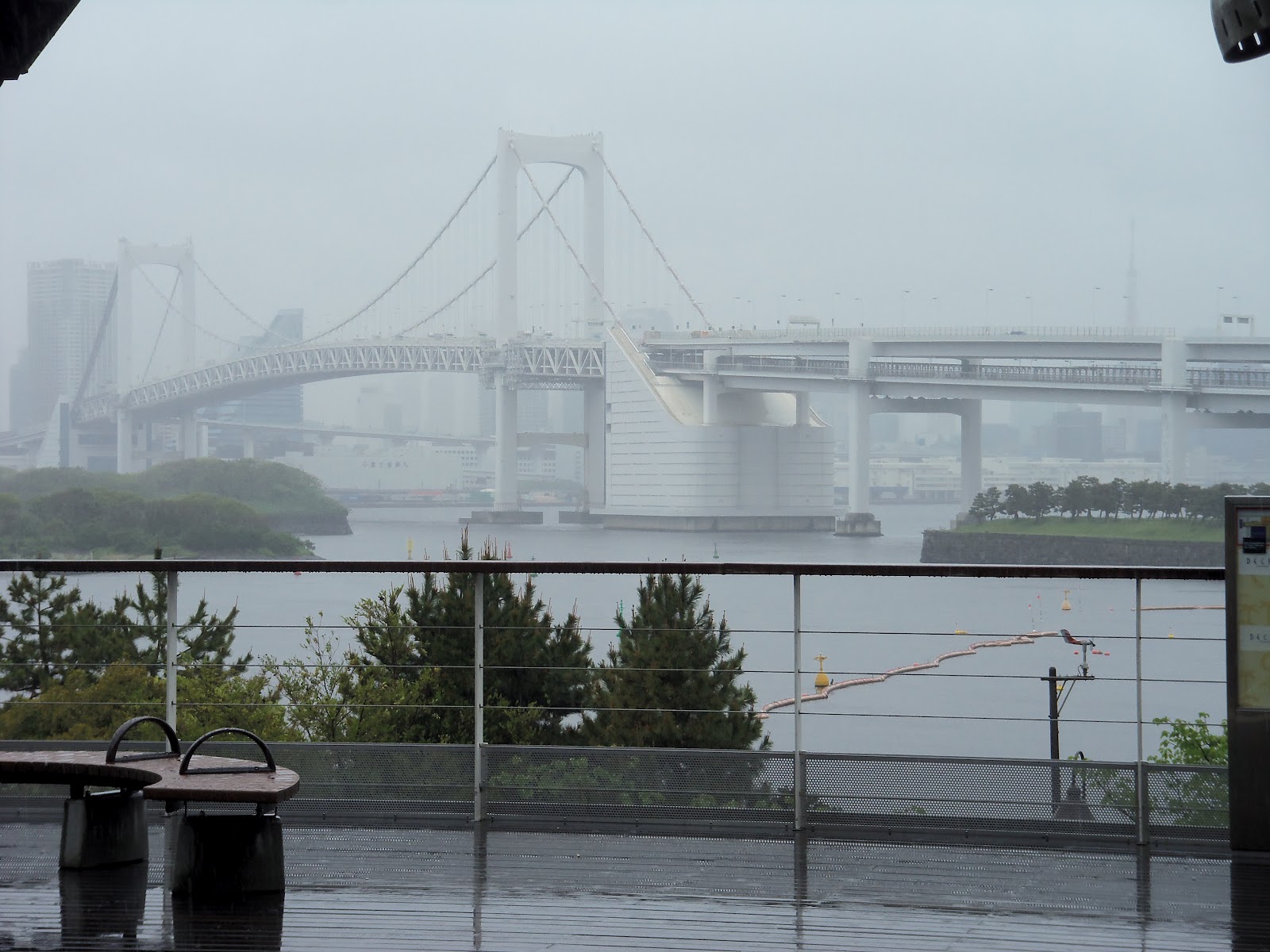
This is Rainbow Bridge, the famous Odaiba bridge. It lights up at night in rainbow colors, apparently. It actually looked kinda pretty in the rain, though.

And this is the Odaiba statue of liberty. Japan is a country of imitation? um, well...

Afterwards, we went on Odaiba's giant ferris wheel! It was my first time on a real ferris wheel. It was cool.

Hinata and Tamaki inside of the ferris wheel car. My cutest and sweetest friends!

Then, we went to Odaiba's cat cafe! This was a first for all of us. It wasn't as nice as I thought it would be and it stunk like cats, but petting the cats was so nice~~They were so fluffy and sweet gwaa

Me petting a cat☆

Cat☆

I loved this cat. It was so cute and looked like a stuffed animal.

You weren't allowed to hold the cats unless they made the move on to you. This cat jumped into Hinata's lap so she had lots of fun with it.

This cat jumped onto Tamaki's shoulder. I caught it's angry face...
For the rest of my Golden Week, I hung out with friends in Ikebukuro, Ueno, Akihabara, and Shibuya and it was really busy, but I have no pictures from that, so it wouldn't be very interesting. Plus, I'm sure you're tired of reading all this already, right? Anyways, it was really busy but really fun. Thank you to all of my friends who kept me busy during this time! Now it's back to school...
Being sick in Japan
Hellooo it's been a while! I wanted to post an entry right after my week off from class to talk about Golden Week and such, but unfortunately...I was hit by a really serious sickness right after Golden Week came to an end.
On the night of Monday the 8th, I had a really strong headache, but I ignored it and just went to bed.
The next day, Tuesday, I was feeling kinda bad, but I headed on to school anyways. Maybe it was partially because the train was really crowded--although that's nothing new--but all of a sudden, I started to feel nausious, claustrophobic, and the world started getting fuzzy. Unable to handle it anymore, I got off at Nakameguro and headed to the train station bathroom. On my way there, I could barely walk and kept running into people. It felt like I was gonna die...When I got into the bathroom. I got into a stall and drooped to the floor. Just doing that made me feel kind of better, but I knew I couldn't handle class in that condition. I mean, I couldn't even walk anymore. I sent an email to Hinata telling her I was sick, took some advil, curled up on the stall floor, and slept. For two hours. When I woke up, I was feeling somewhat better. I could at least stand, so I headed back home and slept again. The next day, I woke up with cold symptoms--sore throat, stopped up nose, fever, etc. This time, it was worse than the last time I got sick, so taking the advice of my friends and family, I headed to the doctor.
And so, I have experienced a Japanese doctor's office! Yes, I was sick and it wasn't especially fun, but I looked at it as somewhat of a cultural endeavor just to stay positive.
When I got to the doctor's office, I filled out a form with my name and essentials and then I had to describe my symptoms. To do this, there was a picture of the body, and you circled the places on it that hurt or were bothering you. I thought that was kind of cute. A few minutes after I handed in the form, the doctor was ready to see me. My doctor was a really funny guy, and I really appreciated his humor and kindness.
I walk in and the first thing he says is: "Avendano, Kenia-san? Where are you from?"
I found that an interesting question because in the U.S., I feel like it's a question that's not often asked in this situation probably because in the U.S., or at least in Maryland, there are so many foreigners that are residents or people with foreigner like names but have lived in the U.S. all their lives. If I ask a 2nd generation Chinese person in the U.S. where they're from, they often say the U.S., which is understandable. I mean, even if their parents are Chinese, they have lived in the U.S. all their lives.
When I told the doctor I was from the U.S., he then asked if Japanese was okay. I told him I can understand pretty well, but speaking is just okay. So he said, "Oh, well, if you ever have problems, you can speak to me in English. I can understand a little." "Oh, really?" I asked. "Yeah," he replied. "But just a little, okay?" Again, I appreciated his humor.
Hearing that my throat hurt, he checked me for strep since it's apparently going around right now, but the test came out negative. However, that wasn't a 100% guarantee that I didn't have strep. He prescribed me some medications, and I went to the pharmacy next door to pick them up. The ladies at the pharmacy were so sweet and were asking me if I was eating properly and everything like moms. These were my medicines:

On the night of Monday the 8th, I had a really strong headache, but I ignored it and just went to bed.
The next day, Tuesday, I was feeling kinda bad, but I headed on to school anyways. Maybe it was partially because the train was really crowded--although that's nothing new--but all of a sudden, I started to feel nausious, claustrophobic, and the world started getting fuzzy. Unable to handle it anymore, I got off at Nakameguro and headed to the train station bathroom. On my way there, I could barely walk and kept running into people. It felt like I was gonna die...When I got into the bathroom. I got into a stall and drooped to the floor. Just doing that made me feel kind of better, but I knew I couldn't handle class in that condition. I mean, I couldn't even walk anymore. I sent an email to Hinata telling her I was sick, took some advil, curled up on the stall floor, and slept. For two hours. When I woke up, I was feeling somewhat better. I could at least stand, so I headed back home and slept again. The next day, I woke up with cold symptoms--sore throat, stopped up nose, fever, etc. This time, it was worse than the last time I got sick, so taking the advice of my friends and family, I headed to the doctor.
And so, I have experienced a Japanese doctor's office! Yes, I was sick and it wasn't especially fun, but I looked at it as somewhat of a cultural endeavor just to stay positive.
When I got to the doctor's office, I filled out a form with my name and essentials and then I had to describe my symptoms. To do this, there was a picture of the body, and you circled the places on it that hurt or were bothering you. I thought that was kind of cute. A few minutes after I handed in the form, the doctor was ready to see me. My doctor was a really funny guy, and I really appreciated his humor and kindness.
I walk in and the first thing he says is: "Avendano, Kenia-san? Where are you from?"
I found that an interesting question because in the U.S., I feel like it's a question that's not often asked in this situation probably because in the U.S., or at least in Maryland, there are so many foreigners that are residents or people with foreigner like names but have lived in the U.S. all their lives. If I ask a 2nd generation Chinese person in the U.S. where they're from, they often say the U.S., which is understandable. I mean, even if their parents are Chinese, they have lived in the U.S. all their lives.
When I told the doctor I was from the U.S., he then asked if Japanese was okay. I told him I can understand pretty well, but speaking is just okay. So he said, "Oh, well, if you ever have problems, you can speak to me in English. I can understand a little." "Oh, really?" I asked. "Yeah," he replied. "But just a little, okay?" Again, I appreciated his humor.
Hearing that my throat hurt, he checked me for strep since it's apparently going around right now, but the test came out negative. However, that wasn't a 100% guarantee that I didn't have strep. He prescribed me some medications, and I went to the pharmacy next door to pick them up. The ladies at the pharmacy were so sweet and were asking me if I was eating properly and everything like moms. These were my medicines:

I had three pills. Two of them (a small round pill and a orange and white capsule) were antibiotics, which I had to take 3 times a day after each meal. Then the large long pink pill was to decrease the swelling in my throat, and I took it once a day each morning. I'm usually terrible at taking pills, but I was able to swallow all of them on my first try each time! Yay I'm getting better at it☆
I was also given a drug history book upon my request just for fun, since it was free. It's cute, right?
I had to take off the whole week last week, even though I didn't want to. It's not fun at all to get sick by myself with no one to help take care of me. (People like me and my dad need someone to cuddle up to and whine about how we're dying when we're sick haha) It's especially difficult getting sick in a foreign country where it's hard to find your way around and express yourself to the doctor.
Luckily, my cough is still a little persistent, as always, but I'm feeling a lot better. And it is all thanks to the Japanese doctors and medicines (maybe♪).
Monday, April 30, 2012
A dream of apples

Thinking it must be significant, I decided to look it up.
Apparently, when you're given an apple by someone, it's a symbol of love.
The person who gave me the apple in my dream was randomly this guy from my elementary school who I haven't thought about in ages, but...well...
An ripe apple is also considered a good omen with a promise of financial rewards in the near future! Ohh!
But then, depending on the situation surrounding the apple, it may be a symbol of knowledge and freedom...or a symbol of temptation and passions...The surrounding situation after given the apple is kind of strange and difficult to explain, so I'm not exactly sure which symbol it really is...Most of the interpretations I found talked about an apple on a tree or eating an apple or a rotten apple.
Both times, my apple was ripe and red. And both times it was just given to me by the same person. I didn't eat it.
Mysterious...
Then again, it could just represent my desire to eat an apple, which has gotten harder to do since apple prices have risen really high lately...
Oh, well. That's all I could interpret of my dream of apples.
Sunday, April 22, 2012
Japanese spring culture
I almost forgot to post my cherry blossom viewing pictures!
Right now, in Japan, it's supposed to be spring.
I say 'supposed to be' because even though there were a few warm days at first, lately it's been like early winter cold...and it's not fun, especially because it means perfect weather to catch a cold (which I did. However, I am finally better now.)
Anyways, it's really amazing how Japanese people are so sensitive to and enjoy appreciating the changes in weather and seasons. There are special foods and events for each season.
In the spring, Japanese people go cherry blossom viewing ('hanami'). This year, the cherry blossoms bloomed really late in Tokyo. Everything was not completely in bloom until the end of March, beginning of April. But still, I was lucky enough to participate in the famous Japanese tradition with some friends after class on Saturday April 7. We walked to a park near Keio's Mita campus called 'Shiba Koen' (lit. Grass Park).
This was a shrine along the way with its entrance in full bloom.

This is the entrance to the park. It was packed with people doing cherry blossom viewing!

Everyone had their own large blue mats to sit on. There were even tents! Apparently, some really dedicated people stalk out a place and stay overnight...Well, it does get unexpectedly crowded, so I don't blame them. My friends and I almost didn't find a spot.

A view of Tokyo Tower through the blossoms.

It got really cold as the day progressed, so we all went for tea and coffee afterwards.
Before we left, though, we got a guy to take our picture for us.
This is the group I went with: (left to right) Me, Hyo-Jeong, Hyo-Jeong's friend (I forgot her name...), Saki, In, and Azusa.

My dorm was also in full bloom!
I took this picture for mother, because it reminded me of our old backyard.

These are some of my favorite flowers--sakurasou! (primroses) I think their heart-shaped petals are cute...A few of them are growing in my dorm's garden, so I took a picture.

To the Japanese, cherry blossom viewing isn't limited to the daytime. Nighttime cherry blossoms are also considered very beautiful, and nighttime cherry blossom viewing is as popular as daytime viewing. After my conversation club two Tuesdays ago, we all went to go see the blossoms in Nakameguro.
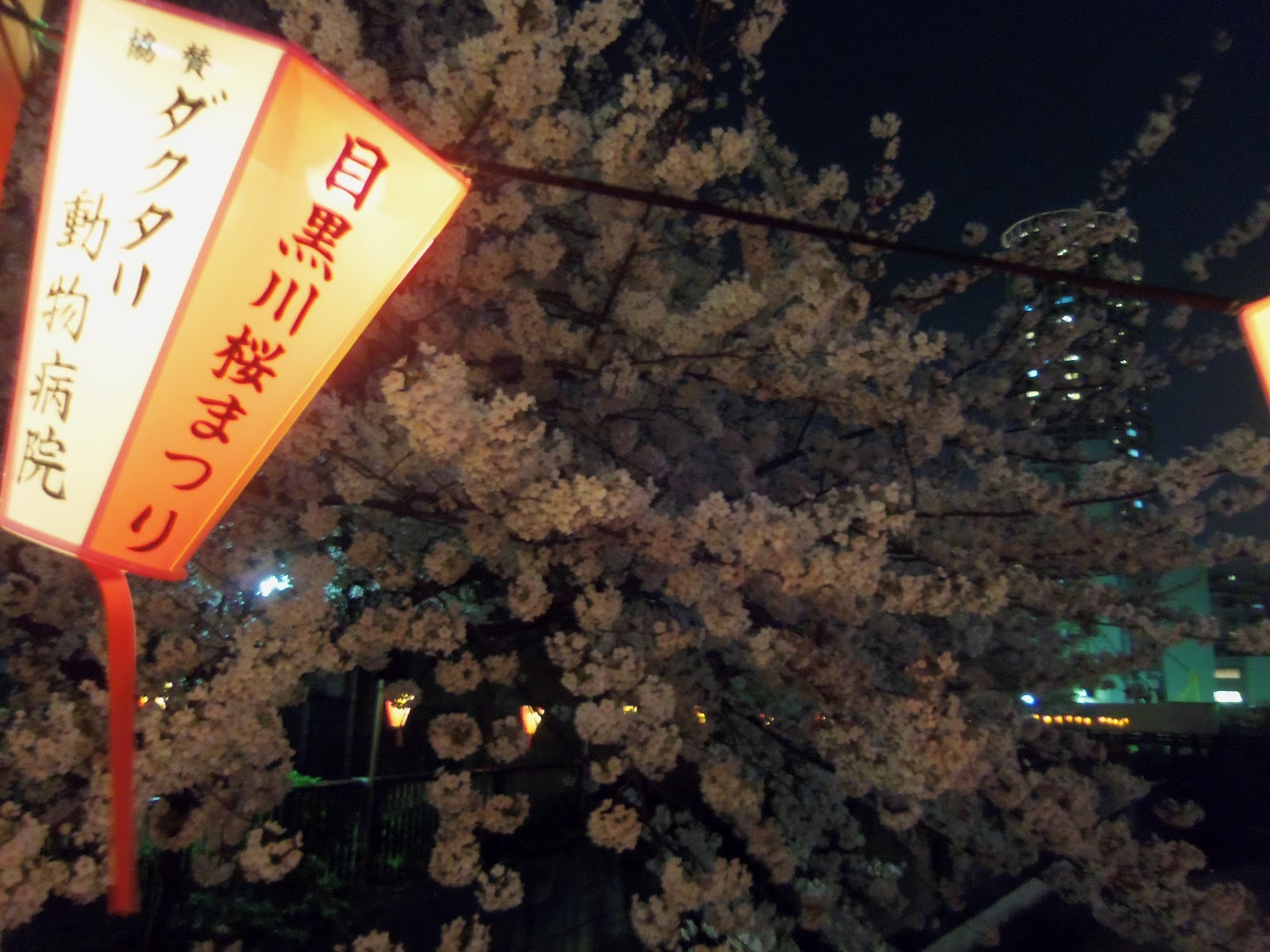
Lanters are lit and groups of friends sit around even on the side of the streets drinking, eating, talking, and taking in the view.

Another traditional Japanese custom that pays special attention to the seasons is tea ceremony.
Because I signed up for a Japanese culture class at my school, I'm able to participate in tea ceremony every Saturday for free! Our teacher is so cute and nice and always wears a beautiful kimono to class.
This is the classroom setting. The trays on the left are our tea trays; the objects in the center are the special charcoal used to fuel the fire to heat the tea kettle and a traditional Japanese candle which was made out of plant fibers rather than wax; the screen in the right corner displays the proverb of the day and below that (really tiny) is the daily flower arrangement.

We learn how to behave at a tea ceremony, how to place our fan, how to fold our napkin, etc. This is the fan and napkin. A fan is just used for decoration and to mark your place in the case that you have to get up during the ceremony. The napkin is used to wipe your utensils as you use them. There's a procedure for everything, which can get confusing sometimes, but at the same time, it's amazingly beautiful and elegant.

The little box on the side is the tea container--the design is for the doll's festival--and we are given a tea scoop (the long wooden stick) and a wooden pick to eat our sweet (the shorter stick).
This is the sweet of the day, called 'wagashi' (Japanese sweet). Unfortunately, the teacher only said it was perfectly fine to take pictures after I had already cut it...There's always a larger soft sweet served with chopsticks and a harder tiny sweet that you take with your hands. The sweet of the day yesterday was a pink sugar flower topped mocchi cake filled red bean paste and tiny green tea mocchi squares. You eat the sweet first so that your mouth fills with sweetness to prepare it for the bitter tea.

And the tea is really bitter......Nothing like the matcha lattes at Starbucks haha. I mean, I expected this and I've had matcha tea straight before, but bitter is bitter... I saw that Hyo-Jeong was eating her sweet with her tea rather than simply before it. I realized that was a smart thing to do. I'll do that next time...
By the way, the cup was decorated with a 'kabuto', a war mask used to celebrate boy's day. I was delighted to see my cup, with its boy's day image, and tea container, with its girl's day image, kind of made a pair!

Subscribe to:
Posts (Atom)